Thursday, 15 April 2010

2000 Years of Climate Change Evidence

The scandal over ‘Climategate’ has got a lot of people rethinking their stance on global warming; at least, it has lent fuel to the arguments of those who never wanted to believe it anyway. Most of us have to admit, too, that we’re incompetent to assess the information available. After all, if the issue is proving so troublesome for our top scientists then what chance to do we have?

One of the main problems scientists have is filtering through the available data for meaningful information. There’s a lot of ‘noise’ and a lot of bad science out there and modeling climate is such a complex task that it’s still impossible to predict anything with a degree of certainty.

Still – what if it really was all a myth? What if human influences on climate change were just a bad dream after all?

Historical Climate Change Records

Whether or not climate change occurs is not the issue. We know that it does and that it has been happening for million years. That is the issue. It’s been happening long before humans showed up so who can really say for sure that recent rises in temperatures have been down to us?

Most famous studies of climate variation over the last few millennia show a marked increase in global averages from the end of the 19th century. For example, the diagram below is borrowed from a 2001 report by the Intergovernmental Panel on Climate Change.


The picture appears to show a stark rise in global temperature through the twentieth century and has been used as clear evidence of anthropogenic global warming. But a growing number of studies have challenged this model. The next diagram is reproduced from a study by Dr Craig Loehle, a professor of mathematics and ecology, who compiled the global average temperature over the last 2000 years using 18 different data sets – without using tree ring data.
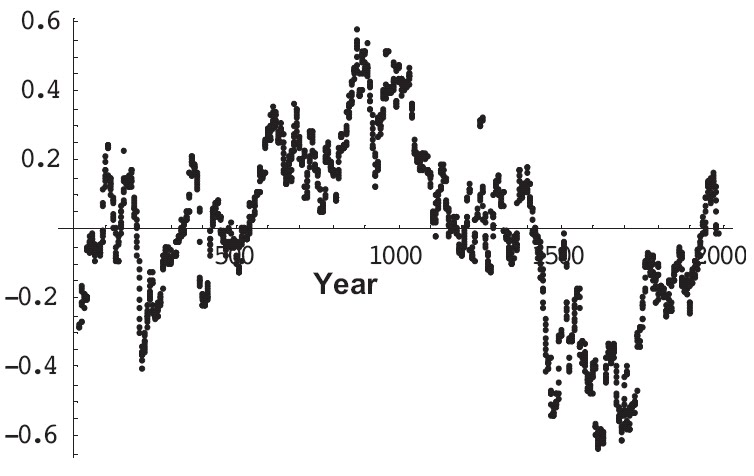


The trends in this diagram are markedly different. One of the main reasons for this is that conventional temperature data is often calculated using dendrochronology but this method can be flawed, as trees react to a number of environmental factors – not just temperature – and may also adapt to changing climate, adding a feedback affect to any results.

In Loehle’s model, temperatures have changed a great deal in the last 2000 years and current temperatures aren’t actually any hotter than they were in 1000AD. There is a clear upward trend from around the start of the Industrial Revolution but we can’t necessarily attribute that to human influences because it’s all happened before.

Assessing Historic Temperature Data

There are potentially a number of problems with both sets of data.

Obtaining historical temperature data isn’t easy, as thermometer records have only existed since the 19th century. There are various techniques for doing it, some more reliable than others. The data in the first diagram includes tree-ring studies that may not have been accurate, while the grey shadow behind the line of best fit indicates just how much doubt there is over the precision of the observed results.

But Loehle’s study doesn’t include nearly enough data to give an accurate global picture. All 18 data sets are from sources by the ocean; 15 of the 18 data sets are from the northern hemisphere; half of the data sets are from a ring around the North Atlantic. The geographical bias indicates that there may well have been correlation between some sets due to local rather than global climate trends.

Even if the 18 data sets aren’t locally correlated, 18 sets of data is a small enough number that even random changes could appear to show trends. Some of the data sets had a granularity of 100 years. Before we even begin to factor in calculation error there’s a lot of room for interpretation and interpolation.

I set up an excel spreadsheet to generate random temperature trends, with maximum 100 year changes of 1C, and employed averaging techniques at points separated by 20 years. A representative sample of the results is shown below.


While the variance in these graphs isn't quite as high as that in Loehle's data, it does shows that 18 limited, independent sets could quite easily have shown apparent trends, such as the highs and lows produced by the Medieval Warm Period and the Little Ice Age, even if there was no real trend and the temperatures were fluctuating independently and randomly. Local changes in climate at each of these points do not necessarily point to a global trend.

The Truth about Global Warming

The point of all this has been show that our knowledge of past climate change is still patchy and that the evidence for claiming ‘this has all happened before’ is just as patchy as the evidence showing that temperature rise in the 20th century has been unique.

And even if the statistics were accurate they tell us nothing about the causes. There are many possible natural influences on climate change – changes in the solar output, changes in the Earth’s orbit, continental drift, volcanic activity, shifts in sea currents – and a number of secondary feedback processes, such as changing albedo from ice and cloud cover, which can serve as amplifiers.

But it’s also possible that atmospheric composition, as influenced by humans, could do the same. Regardless of whether it was caused by man or is part of a natural cycle, there was a definite upswing in temperature in the 20th century. We have far more data about the last 100 years than any other period before it, enough to show global temperature changes with an accuracy that can’t be achieved from a few sporadic data sets. What we lack is knowledge of the mechanisms governing the change.

So the truth about global warming? It's real. But we don't know for sure if it's down to humans, and we probably won't until it's too late.

Monday, 29 March 2010

The real benefits of organic produce

The FSA reckon that organic food is no better nutritionally than conventional food products. Personally, I reckon they’re probably right – in fact conventional food may actually contain higher amounts of essential carcinogens from all those wonderful chemical inputs that get sprayed onto the crops. We all need our daily dose of cancer, after all.

To focus on the health benefits though does kind of miss the point though. There are far more compelling reasons to eat organic food than a slightly reduced risk of bowel cancer (though obviously that would be nice). The advantages of organic farming lie elsewhere - organic farming is far better for the environment, while organic farmers have a far more secure livelihood in times of economic depression.

Commercial farming is one of the leading causes of soil, air and water pollution. A portion of this pollution is formed from animal waste, which is common to both organic and industrial farming methods. But another major component is that which results from chemical pesticides, fertilisers, hormones and other industrial treatments.

Organic farming is not entirely free of these treatments (though biodynamic farming, and extreme form of organic agriculture, is) but the exposure of the environment to potentially harmful chemicals is much reduced.

For farmers an even more convincing argument is that organic farming can make sound economic sense. Organic farmers are better protected against fluctuations in the market than those which rely on chemical inputs precisely because they don’t have to spend money on those products.

Conventional farmers are slaves to chemical inputs; they need to make a certain amount every year just so they can afford to buy fertiliser and pesticides for the one following. They often have to take corporate contracts as a measure of security, which places power firmly in the arms of supermarkets and international food production companies rather than the farmer himself.

Organic farmers, while not entirely self-sufficient, have much reduced costs. This means they are better able to ride out fluctuations in the market and don’t need to put their future in the hands of corporate buyers who in some cases can use their purchasing power to force prices artificially low.

The life of an organic farmer is hardly idyllic and there are a number of risks involved as well – not least the potentially increased risk of disease among cattle. But the global recession has meant that an increasing number of farmers have started to see the attraction of going organic. In France last year, the number of organic farmers grew by 20%, compared to 2.5% in each of the previous 8 years. The reason? They’re sick of getting 20p for a gallon of milk that costs 40p to produce.

The French government have been helping them make the switch as well, handing out tax credits as a carrot to encourage the change. French farmers are voting with their feet and there appears to be the makings of a new organic revolution there.

So who cares whether organic food is actually better for you? You should buy it anyway. Because buying organic food helps to protect both the environment and give some power back to the farmers – the latter of which has to be a good thing, given the mess that the money men and politicians have made of things in recent years.

Thursday, 25 March 2010

Is a Green Investment Bank Really a Good Idea?

Alastair Darling has announced the formation of a new green investment bank in the latest budget. Great, that’s just what we need – more middle men lining their pockets at the expense of the wider economy. Seriously, it may sound like a good idea, but I'm not so sure that it is. Wouldn’t the money be better spent elsewhere? Do we really want to be injecting more cash into an industry that’s all but brought the world to its knees over the last two years?

Of course, this could all be a publicity stunt. The bank is being formed from £1 billion of government money and £1 billion of private investment; that make sound like a lot but it’s a pittance compared to how much is needed. Some estimates are that the UK needs around £500 billion investment in green infrastructure over the next ten years. My inner cynic, who may be slightly less inner than I am prepared to admit, suggests that this figure is likely to be conservative as well. Government projects have a long and glorious history of being delivered over-budget so we can probably slap a few hundred billion on that figure right now.

Regardless of budgeting issues though, the most pressing question is this – how would a green investment bank actually work?

As far as I understand it (and correct me if I’m wrong) the purpose of any investment bank is to make money through investment. So a green investment bank would ultimately be looking to make money from green projects if it wasn’t going to continued being subsidized by the government. But if there was a lot of money in green projects then we probably wouldn’t have to have a green investment bank because the industry would have taken off years ago.

Many green projects do undoubtedly turn a profit in the long run, even on a small scale. If you add solar power to your home it might cost you a few thousand pounds but you’ll have made that money back within fifteen years in most cases.

However, one of the main reasons that the UK lags behind its European counterparts on conversion to a green economy is the lack of a quick and secure return on time and money spent on green projects. The Anglo-American business model provides fewer incentives for businesses to get involves; neither is a fifteen year return on £2 billion going to make a dent in the UK’s investment requirements.

Plus, remember that you’ve got to pay the damn bankers as well – the same people who are constantly in the news trying to justify their sixteen figure bonuses as ‘necessary’ to attract ‘talent’. Assuming that we want ‘talent’ for this new bank are we going to have to expend half the invested capital just keeping the middle men happy?

A large factor affecting the costs of green development is the lack of competition within the sector. Take Centrica, for example. Currently the company operates four offshore wind farms and they’re one of the world leaders in wind energy production. But in 2008 they announced that the prospects of turning a profit from wind farms were becoming “marginal” at best. Shortly before the announcement, Shell had pulled out of a joint project to create what would have been the largest wind farm in the world - after the estimated cost of the project had doubled from £1 billion to £2 billion in the five years since its inception.

At the time there was a general feeling that the increase in costs was largely down to a lack of bids for the project – only one company had submitted a tender to produce the turbines themselves and they could pretty much name their price.

And it is this which is the crux of the matter. The UK is a service economy. We’ve struggled for years to get away from our manufacturing roots and in the process we’ve hamstrung ourselves. Over the last twenty years our whole economic model has been tied to a financial sector that has recently been sinking faster than the Titanic.

We don't have the manufacturing resources to create the necessary conglomerates and economies of scale that would increase efficiency, increase competition and ultimately bring down the cost of 'going green'. If we did then we'd find it much, much easier to attract private sector investment.

So rather than injecting yet another £2 billion into yet another bank, wouldn’t it be better to spend the money on re-establishing our manufacturing base? Of course, this might happen anyway - if the bank is run sensibly it will put money into smaller engineering start-ups than pissing it into large projects with spiralling budgets. But if that is the ultimate goal, why do we need the bank? Why not inject it directly into the industry without lining the pockets of some overpaid fat cat middle men?